
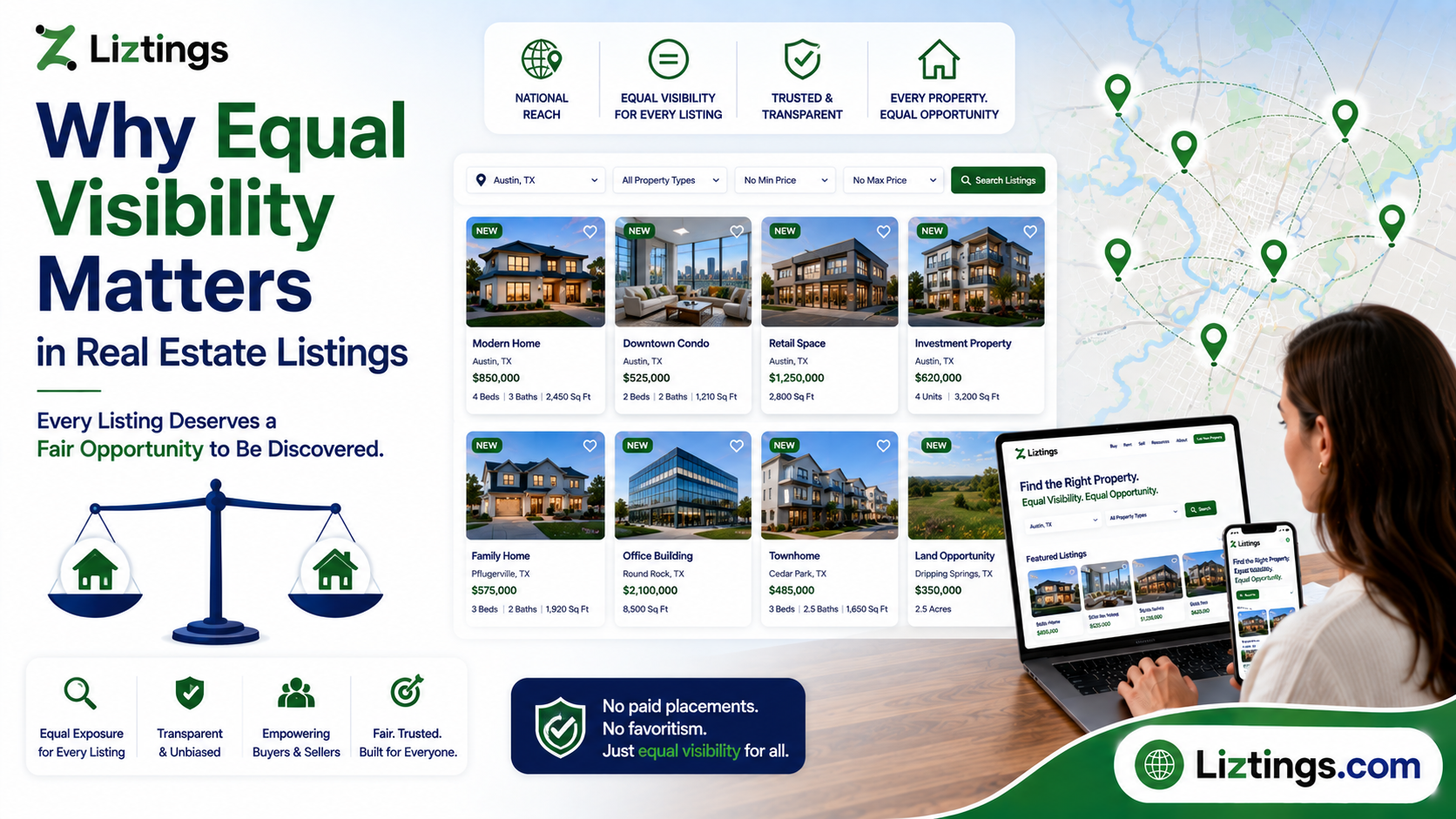
Why Equal Visibility Matters in Real Estate Listings
A real estate marketplace does more than display properties. It determines which homes, commercial spaces and businesses buyers see first, which listings receive attention and which opportunities may be overlooked. When visibility depends on paid promotion, premium placement or hidden ranking rules, the marketplace can become less useful for buyers and less fair for sellers.
Equal visibility means every qualified listing has a reasonable opportunity to appear in relevant searches based on the buyer's criteria, not simply on the seller's advertising budget. It does not mean every listing is identical, appears in the same position forever or avoids normal sorting by price, location, date or relevance. It means that paid status should not quietly decide which opportunities deserve to be discovered.
This principle matters because real estate decisions are high-value, location-sensitive and time-sensitive. Buyers need broad access to available options. Sellers need a fair chance to reach the right audience. Agents, investors and business owners need marketplaces they can trust. A transparent, balanced listing environment supports all of these goals.
What Equal Visibility Means
Visibility Is Different From Availability
A listing may technically exist on a platform but still be difficult to find. If unpaid listings are buried beneath sponsored placements, premium accounts or repeated featured results, buyers may never reach them. Availability without meaningful discoverability provides limited value.
Equal visibility focuses on whether a listing can be found when it matches a user's search. A buyer searching for a three-bedroom home within a certain price range should be able to discover all relevant listings, regardless of whether one seller purchased a promotional package.
Fair Ranking Does Not Mean Random Ranking
A useful marketplace still needs sorting and filtering. Buyers may sort by newest, lowest price, highest price, distance, property type or other clear criteria. A platform may also use relevance signals such as location match, listing completeness and freshness.
The key is transparency. Users should understand why results appear in a certain order. Paid promotion should be clearly labeled and should not quietly replace objective search results. When ranking rules are understandable, users can make better decisions.
Equal Visibility Supports Equal Access to Information
The National Association of REALTORS states that its current MLS policy supports seller choice while providing buyers and their agents equal access to important MLS property information. That principle reflects a broader truth: real estate markets function better when participants can see the available options and compare them on consistent terms.
Equal access does not require every platform to operate like an MLS. It does suggest that marketplaces should reduce unnecessary barriers between a qualified listing and the buyers who are searching for it.
Paid Placement Should Not Be Confused With Quality
A featured position may reflect an advertising purchase rather than a better property, stronger value or more motivated seller. Buyers can misinterpret higher placement as a recommendation when the commercial relationship is not obvious.
The Federal Trade Commission has repeatedly emphasized the importance of making paid relationships and commercial influences clear. In any marketplace, undisclosed or confusing paid ranking can weaken consumer trust. Real estate platforms should distinguish advertising from ordinary search results in a way users can easily understand.
Why Equal Visibility Helps Buyers
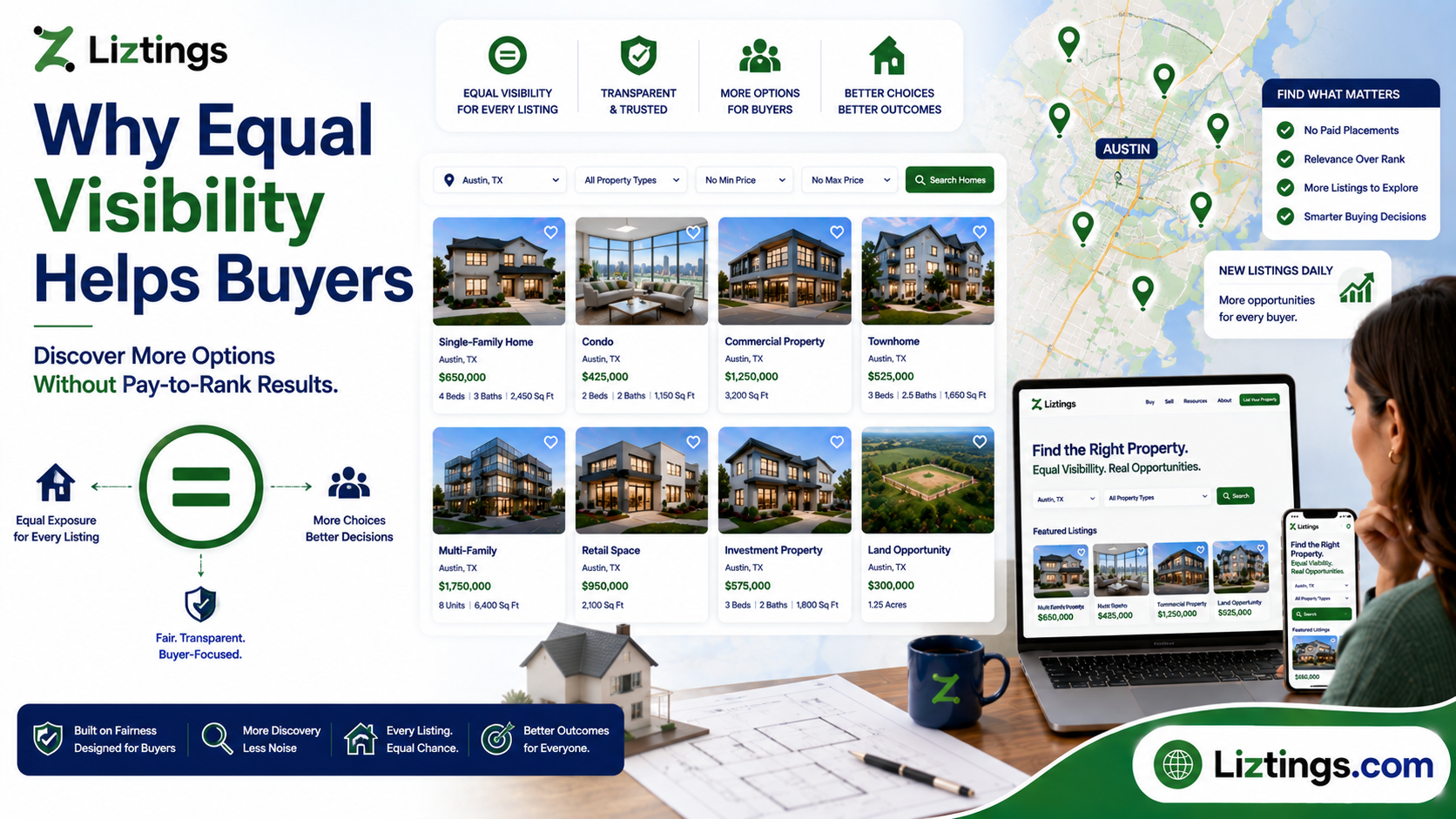
Buyers See More Relevant Options
A buyer's ideal property may come from an individual owner, a small brokerage, a local builder or a business seller without a large advertising budget. Equal visibility makes it more likely that the buyer will discover that opportunity.
When search results overemphasize promoted listings, buyers may see the same properties repeatedly while missing alternatives that better fit their price, location or use requirements. Broader visibility creates a more complete picture of the market.
Comparison Becomes More Accurate
Real estate decisions depend on comparison. Buyers evaluate price, condition, size, location, taxes, fees, restrictions and potential future costs. Those comparisons are less useful when the visible inventory has been shaped primarily by promotional spending.
A balanced result set helps buyers understand what is available at different price points. It can reveal whether a property is competitively priced, whether another neighborhood offers better value or whether a commercial opportunity has stronger terms.
Search Results Become More Trustworthy
Trust matters because buyers often begin making decisions before speaking with an agent, lender, inspector or attorney. The first search results can shape their expectations about price and availability.
If users believe results are arranged to favor whoever paid the most, they may question the platform's objectivity. Transparent equal-visibility rules create a clearer relationship between the user's search and the results shown.
First-Time Buyers Benefit From Clearer Discovery
Experienced investors may know how to search across multiple sources, contact local professionals and identify overlooked opportunities. First-time buyers are more likely to rely heavily on a single marketplace.
A fair search environment reduces the chance that less experienced users will confuse advertising prominence with market importance. Clear labels, complete data and neutral sorting tools help users learn as they search.
Investors Gain Access to Smaller Opportunities
Real estate investors often look for properties or businesses that do not have large marketing campaigns. These may include small multifamily properties, local businesses, owner-listed commercial spaces or properties in emerging areas.
Equal visibility allows smaller listings to compete for attention based on their actual characteristics. That does not guarantee investor interest, but it gives the opportunity a fair chance to be evaluated.
Commercial and Business Buyers Need Broad Market Coverage
Equal visibility is especially important beyond residential real estate. A buyer searching for a restaurant, warehouse, office, retail space or operating business may have highly specific needs. The right opportunity may be one of only a few suitable options.
If smaller listings are pushed far below paid placements, the buyer may never see a location or business that closely matches those needs. In specialized markets, missing one relevant listing can materially affect the search.
Why Equal Visibility Helps Sellers
Small Sellers Can Compete With Larger Advertisers
Individual homeowners, small landlords, independent business owners and local brokers may not have the advertising budgets of national companies or large development groups. A pay-to-rank system can make those sellers less visible before buyers evaluate the actual listing.
Equal visibility gives every seller a reasonable opportunity to compete on price, location, condition, information quality and overall value. It does not promise an offer, but it prevents advertising spend from becoming the main gatekeeper to discovery.
The Listing's Quality Matters More
When promotion is not required to reach buyers, sellers have a stronger reason to improve the substance of the listing. Accurate descriptions, useful photographs, complete details and realistic pricing become more important than purchasing a better position.
This improves the marketplace for everyone. Buyers receive clearer information, serious sellers stand out through preparation and low-quality listings cannot rely only on paid visibility.
Owners Receive a Fairer Test of Market Interest
A seller needs to know whether buyers are responding to the property itself. If an unpaid listing receives almost no exposure, low activity may reflect the platform's ranking rather than the market's opinion.
Equal visibility creates a more meaningful test. Showing requests, inquiries and saves are more likely to reflect buyer interest when the listing has had a fair opportunity to appear in relevant searches.
New Listings Are Less Likely to Be Buried
Fresh inventory matters to buyers. A fair marketplace should allow new listings to be discovered without requiring an immediate advertising purchase. Clear sorting by newest or recently updated can help users identify new opportunities.
This is particularly important in fast-moving segments where a listing may receive its strongest attention during the first days on the market.
Sellers Can Reach Niche Buyers
Some properties are not designed for the widest possible audience. A unique commercial building, rural property, investment opportunity or specialized business may need only one highly relevant buyer.
Equal visibility supports that match by allowing buyers to filter for specific features. The seller does not need mass attention; the seller needs discoverability among people searching for the right criteria.
Free Listing Becomes Meaningful
A platform may advertise free listings while reserving meaningful visibility for paid users. In that situation, free participation can become symbolic rather than practical.
A genuinely free marketplace should provide a usable path from listing creation to buyer discovery. Optional advertising may still exist, but the basic listing should not be intentionally hidden or treated as inferior merely because the seller did not pay.
How Pay-to-Rank Systems Can Distort a Marketplace
They Can Create a False Sense of Popularity
Repeatedly featured listings may appear more desirable or important even when they are simply more heavily promoted. Buyers can mistake frequency for demand and placement for endorsement.
This distortion is especially concerning when sponsored status is not clear. Users should be able to distinguish a paid advertisement from an ordinary listing result.
They Can Narrow the Buyer's View
A search page has limited space. Every promoted result that displaces a more relevant listing reduces the buyer's exposure to the broader market. Over time, the user may see a smaller and less representative set of options.
This does not mean advertising has no place in real estate. It means paid promotion should not prevent buyers from accessing complete, objective search results.
They Can Penalize Accurate Pricing
A fairly priced property may receive less exposure than an overpriced promoted listing. The buyer sees the promoted listing first, while the better-value option is buried.
This can reduce the marketplace's ability to reward realistic pricing. Search order should help buyers locate relevant properties, not create an advantage unrelated to the asset itself.
They Can Reduce Confidence in Platform Data
When users suspect that rankings are primarily commercial, they may distrust other information on the site. Questions arise about featured labels, recommendations, popularity indicators and suggested listings.
Trust is difficult to rebuild once users believe the platform is steering them without clear disclosure. Transparent rules and equal baseline visibility help preserve confidence.
Equal Visibility and Fair Housing
Digital Housing Advertising Has Real Consequences
The Fair Housing Act protects people from discrimination when they rent or buy a home and in other housing-related activities. HUD has also issued guidance addressing how the Act applies to digital platforms, including automated advertising systems and audience targeting.
Equal visibility by itself does not guarantee fair-housing compliance. Listing content, targeting, delivery, user data and platform design all matter. However, broad and neutral access to housing information is consistent with the goal of preventing hidden barriers from shaping who can discover available housing.
Algorithms Should Be Reviewed for Unequal Outcomes
Automated ranking systems can create unintended differences in who sees certain listings. A platform may not intend to discriminate, yet its data, targeting choices or optimization goals can still produce unequal delivery.
Marketplaces should review their systems, document ranking factors and provide clear controls. Fairness requires more than avoiding explicit exclusion; it also requires examining how technology operates in practice.
Listing Descriptions Must Remain Compliant
Equal visibility does not excuse discriminatory advertising language. Residential listings should describe the property, amenities and location without expressing preferences or limitations based on protected characteristics.
Sellers and platforms should maintain content standards, reporting tools and review procedures. Fair visibility works best when paired with accurate, lawful and respectful listing information.
What a Fair Listing Marketplace Should Provide
Clear Search and Sorting Controls
Search results based on the user's stated criteria.
Visible options to sort by date, price, location or other objective factors.
Clear explanations of recommended or relevance-based sorting.
Easy access to all matching listings rather than only promoted inventory.
Transparent Advertising Labels
Paid placements identified in plain language.
Sponsored results visually distinguishable from ordinary results.
No confusing badges that imply quality when they reflect payment.
Clear disclosure of commercial relationships that affect ranking.
Consistent Listing Standards
Required property or business details applied consistently.
Accurate categories and location information.
Rules against duplicate, misleading or discriminatory listings.
Fair moderation and correction procedures.
Useful Filters Without Hidden Penalties
Filters for price, property type, size, location and relevant features.
No requirement to pay before appearing in normal filtered results.
Equal treatment of owner, broker, developer and business listings.
Search tools that help niche opportunities reach the right audience.
Accessible Performance Information
Sellers should receive understandable information about views, inquiries and listing status when available. Metrics should not be designed mainly to pressure users into buying promotion.
Performance data is most useful when it helps a seller improve price, content or completeness. The platform should make a clear distinction between improving the listing itself and purchasing advertising.
How Sellers Can Compete in an Equal-Visibility Marketplace
Price Realistically
Equal visibility gives the listing a chance to be seen, but the market still evaluates value. Review comparable properties, active competition, condition and total ownership costs.
Complete Every Relevant Field
Buyers use filters. Missing information can keep a listing out of relevant searches even when the platform does not favor paid users. Provide accurate price, location, property type, size, features, fees and contact details.
Use Accurate, Useful Photography
Clear photographs help buyers understand the opportunity. Show the most important spaces, exterior, condition and distinctive features without misleading editing.
Write for Buyer Questions
A strong description explains what the listing is, where it is, what is included and what makes it relevant. Specific information is more useful than exaggerated claims.
Keep the Listing Current
Update availability, price and material facts promptly. Remove listings that are no longer active. Fresh, accurate inventory improves buyer trust and seller response quality.
How Buyers Can Use Fair Search Results Effectively
Set Clear Criteria
Define the price range, location, property type and essential features before searching. This allows objective filters to do more of the work.
Try More Than One Sort Order
Compare newest, lowest price and relevance-based results. A different sort may reveal listings that do not appear near the top under the default view.
Review the Full Listing
Visibility creates the opportunity for discovery, but buyers still need due diligence. Confirm taxes, fees, condition, restrictions, permits, financial performance and other material details.
Do Not Assume Top Placement Means Best Value
Even in a fair marketplace, the first result is not automatically the best choice. Evaluate each property or business using the criteria that matter to your decision.
Why Liztings Is Built Around Equal Visibility
Liztings was created around a simple principle: every listing deserves a fair opportunity to be discovered. Residential properties, commercial real estate, businesses for sale and business opportunities should compete through their actual value and relevance, not through a pay-to-rank system.
Equal visibility supports buyers by expanding discovery. It supports sellers by giving free listings a meaningful chance to reach the market. It supports the marketplace by making search results easier to trust.
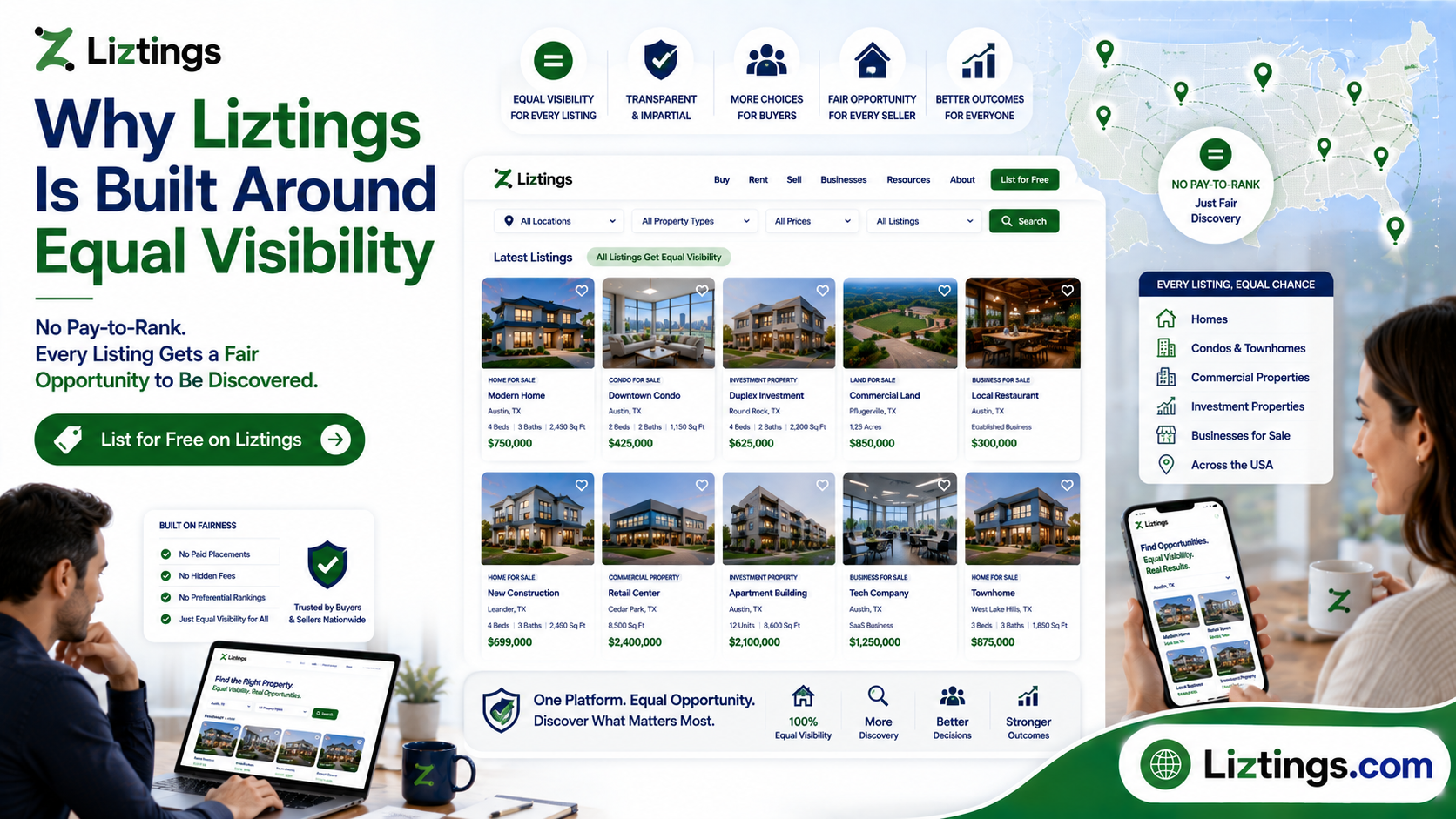
Advertising budgets should not decide which opportunities count. On Liztings, every listing receives equal visibility, and listing is free.
Sources and Editorial Notes
National Association of REALTORS, MLS Policy and Multiple Listing Options for Sellers, including equal access to important MLS property information.
U.S. Department of Housing and Urban Development, Fair Housing Act overview and guidance on digital-platform advertising.
Federal Trade Commission, advertising, paid ranking, endorsement and commercial-disclosure guidance.
Consumer Financial Protection Bureau, housing and fair-housing consumer resources.
This article is educational and discusses general marketplace principles. Equal visibility does not replace legal compliance, fair-housing review, accurate listing information or buyer and seller due diligence.
SEO Details
Category: Real Estate
Tags (comma-separated): equal listing visibility, real estate marketplace, property listings, fair housing, free real estate listings
SEO Title in 0/60: Why Equal Visibility Matters in Real Estate
Meta Description in 0/160: Learn why equal visibility helps real estate buyers and sellers, improves marketplace trust and gives every qualified listing a fair chance to be discovered.
Focus Keyword: equal visibility in real estate listings
Primary Keyword: equal listing visibility
Additional Keywords (comma-separated): fair real estate marketplace, pay-to-rank listings, free property listings, listing visibility, real estate search transparency
Canonical URL: https://www.liztings.com/blogs/why-equal-visibility-matters-in-real-estate-listings